
Keeping Up with Costs – Why It’s Time to Check Your Insurance Valuation and 10 Year Plan

We all know that life has gotten a bit more expensive lately, and the construction industry is certainly no exception. If you’ve tried to book a tradie or buy building materials recently, you already know the story.
In our article in 2024, we shared a look at how construction costs had taken massive leaps – especially in 2024, when the cost of building things like villas and local shops skyrocketed by around 30% in places like Adelaide and Perth.
Now that we have the full picture for 2024, plus new data covering 2025 and projections for 2026, we can see where the market is moving. The good news? The wild, unpredictable spikes are starting to calm down. The bad news? Prices aren’t dropping; they are just settling into a “new normal” at a much higher baseline.
For everyday villa owners and apartment residents, understanding this shift is the secret to protecting your biggest asset and avoiding nasty financial surprises down the track.
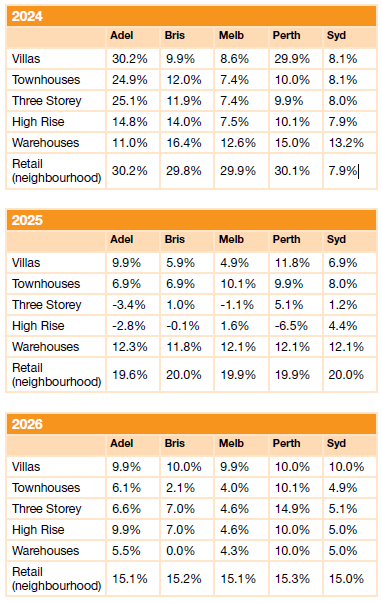
(Source: Updated Rawlinsons Data)
A Quick Look Back: The 2024 Rollercoaster
2024 was full of surprises. While places like Sydney and Melbourne saw relatively normal cost increases for townhouses and apartments, other parts of the country felt a massive squeeze:
- Villas and Neighborhood Shops: These saw huge price jumps. Building costs for these properties surged by about 30% in Adelaide and Perth. Brisbane and Melbourne also saw retail building costs jump by nearly 30%.
- Warehouses: Industrial buildings became significantly pricier across the board, led by Brisbane at 16.4% and Sydney at 13.2%.
2025: Begins to Steady
As 2024 was a bit chaotic, 2025 was the year the market started to correct itself. But it didn’t happen the same way for every property type.
As you can see, higher-density buildings, like high rises and three storey blocks, actually saw building costs cool off, even dropping slightly into negative percentages in Adelaide, Melbourne, and Perth.
On the other side, local shopping strips and warehouses kept charging ahead with double-digit cost increases right across the country, showing that commercial and retail properties are dealing with a completely different set of budget pressures.
2026: The New Normal
Although the effects of the US Iran conflict are yet to be seen, looking ahead through 2026, the wild ups and downs are finally levelling out into a smoother, more predictable path.
For instance, the cost of building villas is settling into a steady 9.9% to 10.0% increase across every major capital city. High-rise buildings are also bouncing back to a steady 4.6% to 5.0% increase on the Eastern Seaboard, and around 10% in Adelaide and Perth.
Local neighborhood shops are projected to go up by a uniform 15% across the board. What does this tell us? The rollercoaster ride is over, but we are still parked at the top of a very high hill.
The Hidden Trap: Compounding Costs
It is easy to look at a headline saying “inflation is cooling” or “costs are stabilising” and assume our strata budgets are totally fine. But there is a catch: compounding numbers.
When a 30% jump in 2024 is followed by a 10% rise in 2025, and another 10% rise in 2026, the total cost to completely rebuild a building has changed drastically over a short 3 year window.
Strata insurance has to cover the worst-case scenario – demolishing the old building, clearing debris, paying council and architect fees, and rebuilding from scratch at current market rates. If your building’s insurance valuation hasn’t been officially reviewed by a professional in the last 12 to 18 months, there is a very high chance your scheme is underinsured. If a major disaster happened, the payout might not cover the full rebuild, leaving owners to foot the bill via an expensive special levy.
What Can You Do? Three Smart Steps for Committees
The facts are clear: older financial plans simply don’t match today’s building costs. To protect your pocketbook and your peace of mind, here are three things your strata committee should look at doing sooner rather than later:
- Get an Up-to-Date Insurance Valuation: Don’t just let your policy automatically renew with a basic 2% or 3% increase. Ask a registered valuer to look at what it would actually cost to rebuild your specific property using today’s local data.
- Review the 10 Year Plan: If your 10 Year Plan was drawn up a few years ago, it didn’t factor in these new, higher prices for labour and materials. Reviewing it early ensures you have enough money put away for future big jobs like roofing, painting, or concrete repairs.
- Remember Local Building Rules: Keep in mind that building regulations add extra steps to repair jobs. For example, compliance laws like the Design and Building Practitioners Act in NSW require extra engineering paperwork for major repairs, which adds to the overall project cost.
At the end of the day, taking a proactive look at your strata’s insurance and 10 Year ‘savings’ Plan isn’t about worrying; it’s just good housekeeping. By adjusting to today’s reality now, your community can stay financially secure and well protected for the future.
View Comments
(0)