
Making Value Visible in Strata Management

CHU’s new 2026 Strata Index highlights a significant opportunity for strata professionals to make their value more visible to owners.
In strata management, much of the work that matters most happens behind the scenes, from managing risk and clarifying responsibilities to guiding complex decisions before issues escalate. Yet the Index shows this value is not always fully recognised by strata owners. Often, the issue is not whether value is being delivered, but whether owners understand who is delivering it, where responsibility sits, and how professional advice helps reduce complexity and risk.
For owners, value is experienced when something difficult becomes easier, something unclear becomes manageable, or something risky feels properly guided. This is one of the sector’s clearest opportunities, making professional value easier to recognise through clearer, more purposeful communication.
Strata manager value is strongest when it is visible
For strata managers, the key challenge is visibility.
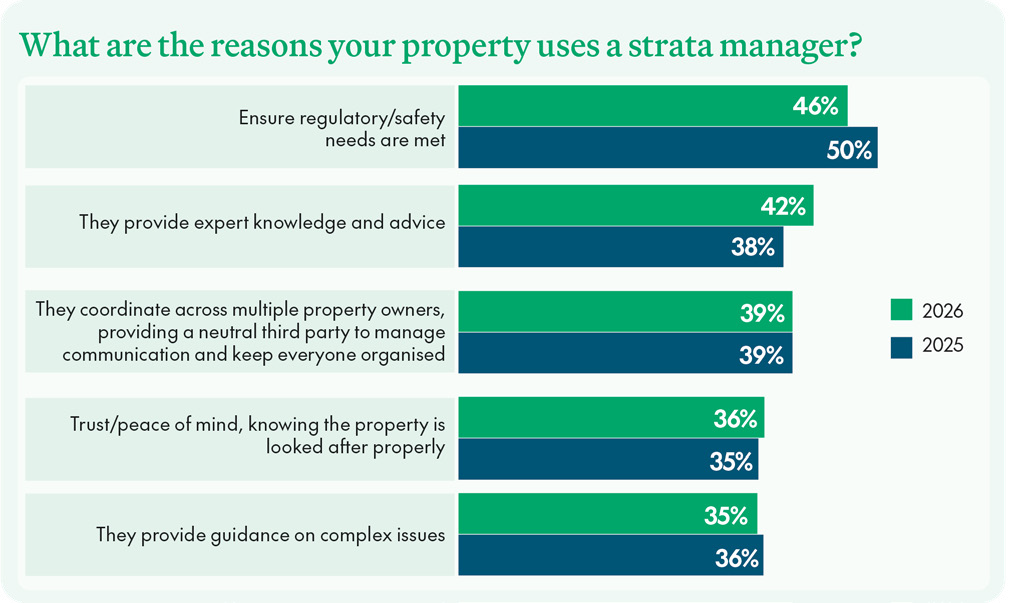
Two-thirds of strata schemes have a strata manager, and of those, 70% are satisfied. Owners most value strata managers for ensuring regulatory needs are met, providing expert advice and coordinating communication. see figure 1. These functions help owners feel the property is properly administered and that obligations are not being missed.
Figure 1 – Top 5 reasons for using a strata manager
Most strata communities describe the relationship as collaborative, and satisfaction increases with its depth. Dissatisfaction is highest where the strata manager is seen as “not very involved”. Owners also want better communication, with 64% preferring more frequent or somewhat more frequent updates.
More communication, however, does not automatically mean better communication. The opportunity is to make communication more useful by clearly explaining about what has happened, why it matters, what decision is required and what happens next.
For strata managers, this might mean explaining why quotes are being sought, why a compliance action is required, what the committee needs to consider, or what risks are being managed. It is not about over-explaining every task. It’s connecting it to the owner benefit.
Brokers are trusted, but their role is not always clear
For strata insurance brokers, the challenge is not simply trust. Two in three owners say they trust their broker and believe they offer good value. However, brokers can remain undervalued when their role is not clearly understood.
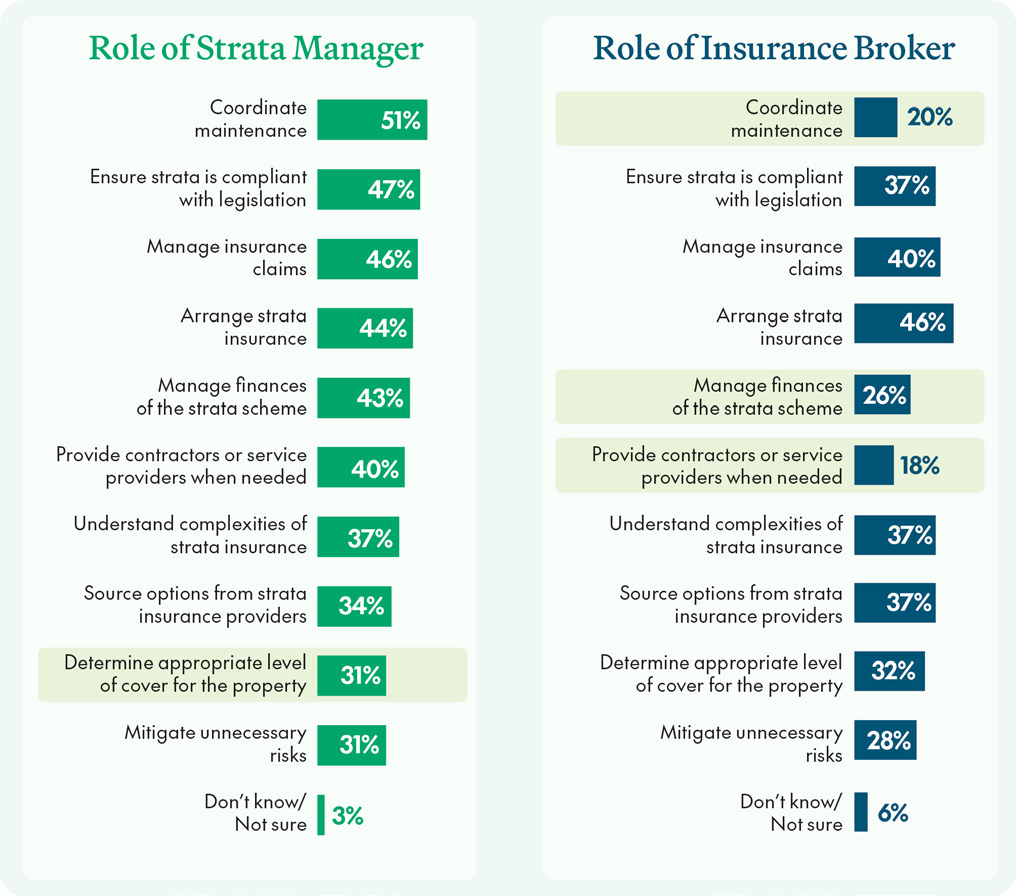
Around half of owners are unclear about the broker’s role, with many incorrectly attributing responsibilities such as coordinating maintenance, managing strata finances or providing contractors – see figure 2. That confusion suppresses perceived value and makes it harder to distinguish broker value from the work of strata managers, insurers or committees.
Figure 2 – Perceived role responsibilities in strata
A broker is not simply “getting quotes”. Broker trust is driven by expertise, while perceived value is more closely linked to cost, ease and convenience. Brokers therefore need to demonstrate both the expertise behind the advice and the practical benefit of a smoother insurance process.
Communication is central to that. A renewal update should not only present the premium. It should explain what changed, what options were explored, what influenced the outcome and what the scheme can do to improve its risk position. This turns an insurance process into a clearer demonstration of advice, diligence and value.
Where roles overlap, clarity matters most
The division of responsibility in strata is not always perfectly neat, and some responsibilities may involve both the strata manager and the broker.
This crossover can make sense within the industry, but from an owner’s perspective it can be confusing. If owners do not understand who is leading, advising, coordinating information and making decisions, they may judge each professional against the wrong expectations.
Where tasks overlap, the workflow needs to be explained – who owners contact first, who provides advice, who coordinates the process, who implements the decision and who approves the action.
Owners rarely value complexity for its own sake
Owners value the confidence that comes from knowing complexity is being handled well. That is the opportunity for strata professionals to make invisible work more visible, roles more understandable, communication more purposeful and professional value more tangible.
The 2026 CHU Strata Index is CHU’s research into strata owner attitudes, expectations and experiences across the strata sector. You can download the 2026 CHU Strata Index at: https://chu.com.au/resource-hub/chu-strata-index-2026/
This article was supplied by CHU.
View Comments
(0)