
The Collective Mind: Your Strata Is Not Your Solo Kingdom

After more than four decades immersed in the world of Australian strata and community schemes, I’ve seen a wide range of behaviour from the good, the bad, and the slightly absurd.
The single most crucial lesson for everyone from first-time owners to veteran committee members is understanding and respecting the concept of the “collective mind.”
We are all familiar with the concept of four levels of government from federal, state, local and strata. My analogy to crystallise the collective mind concept is: I would like to drive my go-kart down the street at speed with no helmet, no blinkers, but apparently the ‘collective mind’ of our state community prohibits me from doing so, however if I’m a lot owner in a strata scheme some lot owners believe they can do whatever they like.
There are deliberate practical and legal governance restraints to this line of thinking. In my view, the key tenets to achieve are:
- Harmonious living in strata, and
- Minimise civil litigation.
Typically, a strata scheme is a corporate entity, but practically speaking, it’s a shared home run by a minidemocracy. The Strata Committee is elected to reflect the collective will, priorities, and fiscal common sense of all lot owners. They are not there to serve the specific demands of one or two influential residents. The moment the Committee forgets this, or allows itself to be steamrolled by a single loud voice, the entire scheme struggles.
The classic problem is the individual owner who believes they are the solo CEO of the entire complex. They might be wonderful neighbours, but they often see the common property as their personal kingdom and expect the Committee or Strata Manager to drop everything to address their singular, often expensive, wish list. While passion is great, strata success relies on acting in the best interests of the Owners Corporation as a whole, which sometimes means politely telling an individual that their proposed $10,000 mural on the shared garage wall is not, in fact, the collective priority this year.
The Strata Manager acts on instructions from the Committee, not from individual lot owners.
The clear path: Translating passion into policy
If you are a lot owner with a strong opinion, or a Committee Member dealing with a particularly persistent resident, you need a defined pathway. It ensures individual concerns are heard, but ultimately tested against the community’s democratic will (collective mind).
The practical communications pathway
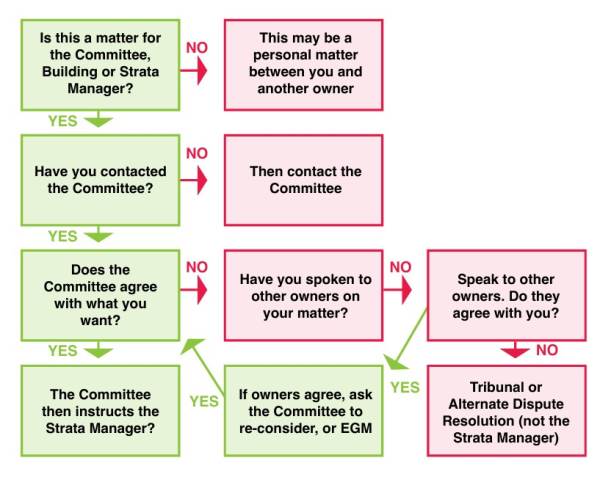
1. Start with the Committee (formal communication)
As a lot owner, submit your request in writing to the Secretary or Chairperson. This is essential because the Committee can only deliberate on items formally submitted and properly documented. The Committee will then discuss the matter at its next scheduled meeting.
- If the Committee agrees: If the proposal is reasonable, within budget, and falls within the Committee’s delegated authority (which is limited for large expenditures or by-law changes), they can pass a resolution and move it forward. Job done!
- If the Committee says no (or can’t decide): If they reject it, or if the issue is too big (like a major special levy or a bylaw amendment), you must move to the next stage. This means seeking support from your fellow owners.
2. Rally the village (Extraordinary General Meeting)
An EGM can be a key democratic mechanism where the “collective mind” speaks directly and the lot owners can hold the Committee’s actions to account. This is a powerful tool. It also allows lot owners to put forward a specific motion and is the moment to campaign, present facts, and convince your neighbours.
If you successfully call the meeting and the resolution passes by the required majority (ordinary, special, or unanimous), the Committee and Strata Manager must carry it out. The collective mind has overridden the previous position.
3. Call in the referee (the Tribunal)
Once you have presented your case, tried to rally the numbers, and the community (the collective mind) does not support your particular position, the democratic, internal options are exhausted. Your only remaining path is to seek external, legal relief via the relevant administrative tribunal, such as NCAT (NSW) or VCAT (Vic).
The Tribunal is not a court of appeal for bad votes, nor to enforce your personal wish list against the majority. It exists to ensure that the Owners Corporation (Council, etc) and its Committee have acted lawfully, fairly, and reasonably. If they have followed the process and the law, and the collective mind has spoken, the Tribunal is unlikely to overturn a democratic decision. This is truly the last stop, typically reserved for issues of genuine breach of duty or legal misconduct.
A final word on harmony
For everyone’s sanity, we must embrace the structure.
- Lot owners: Respect the process.
- Committee Members: Follow the law, maintain transparent records, and remember you are a team acting for everyone.
- Strata Managers: Be the impartial guide and trusted advisor. Your job is to ensure that when the collective mind speaks, it does so lawfully, fairly, and clearly.
Communal living is about compromise, procedure, and accepting that sometimes, democracy means you don’t get your way. Embrace the collective mind, and your strata life will be far more peaceful.
View Comments
(0)